
Lenawee Projected and Actual Release
A projected release date is an estimate, eligibility marker, or planned event based on the authority and record that supplies it. An actual release is the documented moment a person leaves that custody. The two should not be merged. For Lenawee County Jail, a court order or bond entry may authorize release before jail staff finish processing. For an MDOC prisoner, parole eligibility opens a Board process and does not guarantee release.
Pretrial detention has another limit. A person awaiting a case outcome does not have a sentence-based release date. Bond may be posted, a court may change the custody order, or another hold may affect the destination. A sentenced county prisoner may have a calculable term, but the Lenawee County Jail and sentencing court should confirm credit and any lawful reduction.
The broad release-record and named-person paths are covered on the Lenawee County released inmates home page. That path is useful when the date question turns into a request for the actual jail transaction.
Find Lenawee Projected Release Dates
Start by classifying the person as a county pretrial detainee, a county-sentenced prisoner, or an MDOC prisoner. OTIS is the correct public source for a state prison sentence, parole, state felony probation, or a recent MDOC discharge. It expressly excludes county-jail-only prisoners. Sending a Lenawee County Jail name to OTIS can therefore produce an empty result even when the jail has a valid record.
The OTIS offender search accepts a last name or MDOC number and offers status filters. The unique MDOC number is best. After opening the record, review status, sentence detail, location, and each date label. For county custody, call the jail and compare its calculation with the sentence and credit terms in the relevant 2A District or 39th Circuit court record.
- Identify the custodian and case type. Do not route a jail-only sentence through MDOC.
- For a state prisoner, search OTIS by MDOC number when available and confirm the matching identity.
- Read status before reading dates. A prisoner, parolee, probationer, and discharged person have different date meanings.
- For a county sentence, ask Lenawee County Jail for its computation and obtain the judgment or order from the proper court.
- Ask whether another warrant, detainer, correction, or pending decision changes the destination or timing.
- Confirm the actual event through the jail release transaction or the OTIS DATE PAROLED field after departure.
Note: A blank OTIS result may reflect agency scope, retention, a name mismatch, or a set-aside rather than a release.
Michigan Release Date Labels
Michigan uses a distinctive set of date labels. The About OTIS guide defines PAROLE BOARD JURISDICTION DATE as the earliest release date, often called ERD. It marks the point at which the Board gains jurisdiction when available legacy credit is earned and the sentence is not life. The guide expressly says it is not a definite release date.
MAXIMUM DATE is a potential maximum based on the rules and applicable legacy credits. It can change with a lawful credit decision. DATE PAROLED is different. It records the actual day the person left prison. For a probationer, the ERD column serves as the supervision-release date rather than a prison-release promise.
| OTIS label | What it means | What it does not prove |
|---|---|---|
| Parole Board Jurisdiction Date / ERD | Earliest point for Board jurisdiction under the applicable sentence rules | A guaranteed physical release |
| Maximum Date | Potential maximum term date based on applicable credits and decisions | An unchangeable exit date |
| Date Paroled | The date the person actually left prison on parole | Final discharge from MDOC |
| Discharge status/date | The end of MDOC jurisdiction for that sentence | The same event as parole departure |
These labels preserve the difference among eligibility, decision, departure, and discharge. Lenawee probation and parole records then show how community supervision continues after a prison release.
Lenawee Dates Under Michigan Sentencing
Michigan truth in sentencing is not an 85 percent rule. According to the official MDOC explanation, covered people must serve 100 percent of the judicial minimum in prison before parole consideration. The rule applies to specified assaultive offenses committed on or after December 15, 1998, and other covered offenses committed on or after December 15, 2000.
For those prison sentences, good time and disciplinary credits do not reduce the judicial minimum. Class I misconduct can produce disciplinary time that the Board considers, though MDOC explains that it is not formally added to the minimum. The minimum opens parole consideration. The Board must still apply Michigan's release standard, and another hold or sentence can affect what follows.
The official truth-in-sentencing page shows why percentage shortcuts fail in Michigan.
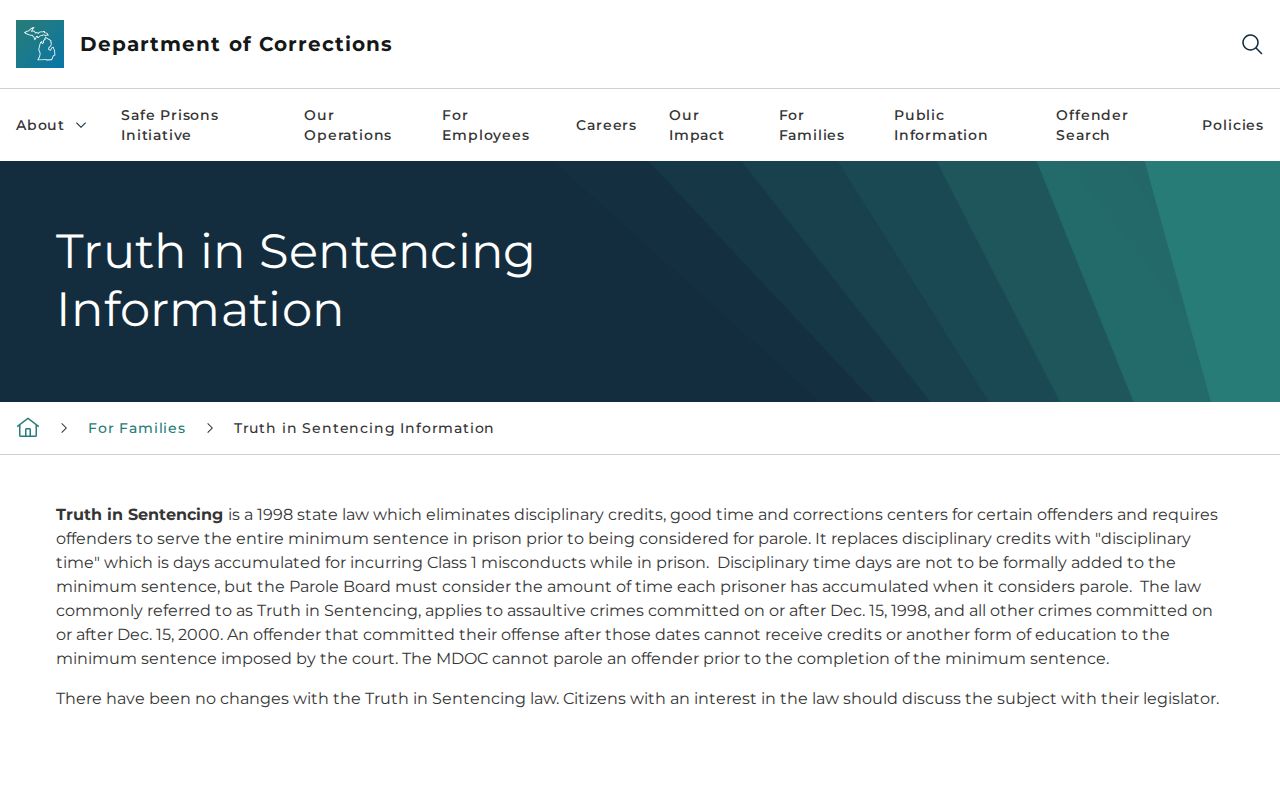
The image supports use of the full judicial minimum for covered cases, not an assumed percentage or an invented guaranteed date.
Older offenses can retain legacy good-time or disciplinary-credit treatment. MCL 791.234 governs key parole jurisdiction and eligibility rules, MCL 791.233 states the release standard, and MCL 791.233b addresses disciplinary time. The offense date and exact sentence must be checked before applying any credit rule.
Lenawee Jail Good-Time Calculation
County jail good time runs in a separate legal lane from MDOC truth in sentencing. MCL 51.282 states that a county prisoner with no rule violations receives one day of sentence reduction for each six days of sentence. The sheriff may prescribe forfeiture for infractions and may restore lost time for minor violations.
That statute does not produce a complete Lenawee County projected release date by itself. The starting term, jail credit for time already served, any correction to the judgment, and the Sheriff's application of good time all matter. Ask the jail for its current calculation and ask the sentencing court for the controlling credit terms. Do not substitute the OTIS ERD because OTIS excludes jail-only sentences.
No official Lenawee weekend or holiday early-release rule was found. A court end date or rough calendar count should not be converted into a promise that the jail will release a person early, at a fixed hour, or through a particular door at a predicted time.
The county rule also allows the Sheriff to forfeit good time for infractions and restore lost credit for minor violations. That makes a simple calendar projection incomplete even after the sentence length is known. A useful request asks for the jail’s current computation, the credit already applied, and the release date produced by that calculation. The response should then be checked against the judgment because the court controls the sentence while the jail administers the county custody record.
Check Lenawee Court Release Dates
Lenawee County has two direct public court portals, and the correct one depends on the case. The D02A MiCOURT search covers the 2A District Court trail, including misdemeanor matters and lower-court activity. The C39 MiCOURT search covers the 39th Circuit Court, which has original jurisdiction over felony cases. When the procedural history is unclear, both trails may be relevant.
Read the register of actions, bond and order entries, disposition, and sentence in context. A bond amount states a condition that may permit release after payment and processing. A sentence entry supplies the legal term, but it does not prove when the person cleared jail procedures. A dismissal or amended order can also precede physical exit. MiCOURT warns that its display is informational rather than the official court record, so request a clerk copy when the exact judgment or order controls the calculation.
The jail supplies the other half of the answer. Ask whether its computation includes credit for time served and the county good-time rule, and whether any hold changes the destination. If the judgment appears wrong, the correction belongs with the sentencing court. If the jail calculation is in question, ask the jail to explain the dates and credits it used. Keeping the court order and jail transaction in separate roles prevents a legal authorization date from being misreported as the actual Lenawee County release time.
Why Lenawee Release Dates Change
A release date can move because the underlying legal or administrative facts change. The effect depends on whether the person is in Lenawee County Jail or an MDOC prison. Some changes affect eligibility. Others affect a decision, planned date, or destination without changing the sentence itself.
| Factor | Possible effect | Source to confirm |
|---|---|---|
| Corrected judgment or jail credit | Changes the starting calculation or time already served | Sentencing court and jail |
| Legacy good-time credit | May be earned, forfeited, or restored under the applicable law | MDOC sentence record or jail calculation |
| Disciplinary time or misconduct | May affect Board consideration or applicable credits | MDOC and official decision record |
| Parole decision | May grant, deny, reconsider, suspend, or rescind planned release | Michigan Parole Board and OTIS |
| Court amendment or set-aside | May alter the sentence or public visibility of the record | Sentencing court |
| Warrant, detainer, or other hold | May change custody or destination after one authority releases the person | Holding authority and releasing custodian |
A transfer is not community release. Likewise, a favorable parole decision is not the exit event. MDOC states that at least 28 days generally separates a Board release decision from physical release while the Parole Release Unit coordinates the date, terms, placement, and notices.
Confirm Lenawee Actual Release Dates
For a county event, use the Lenawee Corrections Division contact and call the jail at 517-265-4400. Ask whether the identified person remains in that custody. If not, ask whether the event was release to the community or transfer. For a durable answer, request the booking and release transaction from Sheriff Records and compare it with the court order. A docket entry alone does not supply the physical exit timestamp.
For an MDOC prisoner, read OTIS status and DATE PAROLED after the person leaves prison. A parolee remains under supervision. DISCHRG means MDOC no longer has jurisdiction for that sentence. MI-VINE can add a reported release notification, but it is an alert layer rather than the certified source record.
For immediate notifications, the resolved VINELink inmate search explains Michigan registration and event limits. Always preserve the distinction between a release alert and a transfer alert.
Lenawee County Jail
549 N Winter Street
Adrian, MI 49221
517-265-4400
County custody and release-versus-transfer confirmation
MDOC Corrections Information
OTIS record assistance
517-335-1426
CorrectionsInfo@michigan.gov