
Gus Harrison Release Destinations
Gus Harrison Correctional Facility is an Michigan Department of Corrections prison for adult men. It is not the Lenawee County Jail. A person can leave the institution for another MDOC prison, enter the community on parole, reach final discharge, or go to another authority. Only an identified community event should be described as a community release.
Parole means the person left prison but continues serving the sentence under MDOC supervision. Discharge means MDOC jurisdiction for that sentence has ended. A transfer changes the place of confinement but does not end custody. Another warrant or detainer may also change the destination after the person departs Gus Harrison. These distinctions explain why a facility location alone cannot answer whether someone is free from all custody.
| MDOC event | Meaning | Public route |
|---|---|---|
| Parole | Community supervision while the sentence continues | OTIS and Region 9 office |
| Discharge | MDOC jurisdiction for the sentence has ended | OTIS or underlying MDOC record |
| Transfer | Custody continues at another institution or agency | OTIS location and agency confirmation |
Search Gus Harrison Release Records
The OTIS live offender search is the primary public path. OTIS covers MDOC prisoners, parolees, probationers, and people discharged within its public display window. It expressly excludes county-jail-only people. Search by MDOC number when possible because that number identifies one correctional record. If it is supplied, other search criteria are ignored.
- Enter the MDOC number. If it is unknown, use last and first name and only the filters needed to narrow the results.
- Compare identity details and any available photograph. Do not select a record on name alone.
- Open the record and read STATUS and LOCATION before interpreting sentence dates.
- Review DATE PAROLED, parole jurisdiction information, maximum date, and discharge information only in the context shown.
- Use MDOC, the supervision office, or the sentencing court when the web extract does not answer the question.
The broader Lenawee County released inmate search explains how the state-prison route differs from the county jail, juvenile, federal, and immigration paths.
OTIS name tools include status filters for active offenders, all records, prisoners, parolees, probationers, discharged people, parole absconders, and probation absconders. A wildcard can follow at least three starting letters of a surname, and the age field searches a small range. These tools help with spelling and name collisions. They do not expand OTIS beyond MDOC scope. If Gus Harrison does not appear as the current location, read the status and other location carefully before assuming community release.
Read Gus Harrison Release Fields
OTIS uses specific terms. STATUS separates prisoners, parolees, probationers, absconders, and discharged people. DISCHRG means MDOC no longer has jurisdiction for that sentence. DATE PAROLED is the actual date the person left prison. LOCATION identifies confinement or supervision, but an absconder’s location is the last supervising place rather than reliable current whereabouts.
PAROLE BOARD JURISDICTION DATE, also described as the earliest release date, is an eligibility point. It is not a promised exit day. MAXIMUM DATE is a potential maximum based on the applicable sentence and legacy credit rules. The Parole Board may grant, deny, or revisit parole, and MDOC states that a release decision generally precedes physical release by at least 28 days. Another hold, court action, or conduct issue can also change the outcome.
Michigan truth-in-sentencing also rules out a common shortcut. Covered sentences require service of the full judicial minimum before parole consideration, not a universal 85 percent. Older offenses may use legacy good-time or disciplinary-credit rules. Eligibility only opens Board consideration. The statutory release standard still applies, and the Board can deny release. A court can amend a sentence, misconduct can affect the process, or another authority can take custody. For those reasons, the date labels must be treated as stages in a sentence rather than one guaranteed release calendar.
Obtain Gus Harrison Release Records
OTIS is a public extract, not a certified discharge certificate. It can provide a status, current or recent location, sentence and offense information, release-related dates, discharge information, and an MDOC photograph when one exists. For a durable agency record beyond the extract, submit a sufficiently specific request through the MDOC records process or obtain the controlling order from the sentencing court.
OTIS ordinarily displays a discharged person for three years after supervision discharge. Older history may require the sentencing court or another permitted state history channel. A qualifying set-aside can cause OTIS removal. Therefore, no result does not prove that a person never served at Gus Harrison, was never paroled, or was never discharged. Check the name, MDOC number, date window, source scope, and possible transfer before drawing a conclusion.
An OTIS photograph is an MDOC image, not a Lenawee County booking photograph. Some older records have no electronic image. The picture can help distinguish two records, but it does not establish current custody by itself. Sentence and status data also may originate with different agencies. If court-derived facts appear wrong, the sentencing court is the correction route. If a supervision status is wrong, use the supervising office. Technical website help cannot rewrite the underlying judgment or field record.
- Parole
- Permission to live in the community while still serving an MDOC sentence.
- Discharge
- The end of MDOC supervision and jurisdiction for the sentence shown.
- Absconder
- An MDOC status reporting lost contact or noncompliance, not a reliable current physical location.
- Set-aside
- A legal action that can restrict public visibility of a conviction record.
Why Gus Harrison Names Change
Older records may use a nearby closed or consolidated facility name. MDOC reports that Parr Highway Correctional Facility consolidated with Gus Harrison on August 9, 2009. The department announced another consolidation of the Gus Harrison south side in 2022 amid a decline in the statewide prisoner population. Neither change means that each person housed there entered the community.
The official Parr Highway history documents the earlier consolidation.
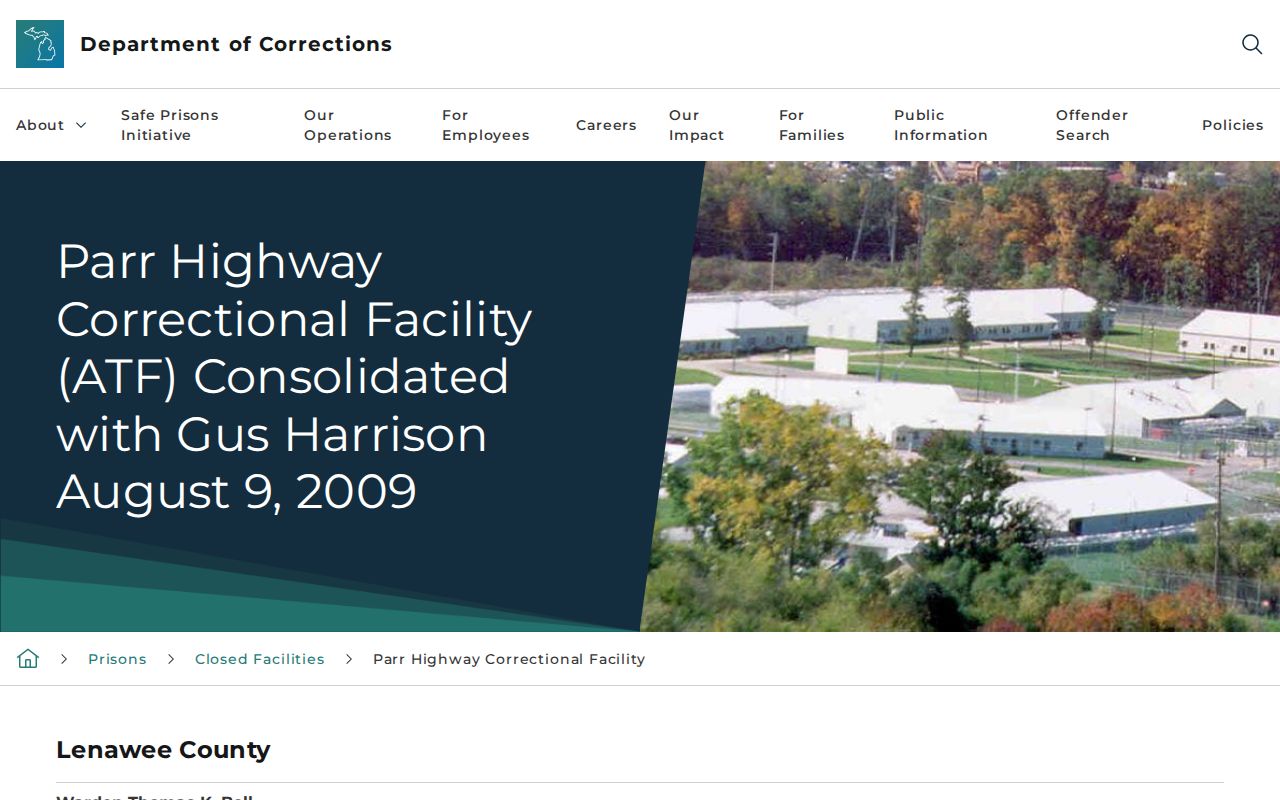
The captured history page helps explain an old institution label, while OTIS status and date fields remain the source for an individual release or transfer.
The 2022 MDOC consolidation announcement gives the later institutional context.
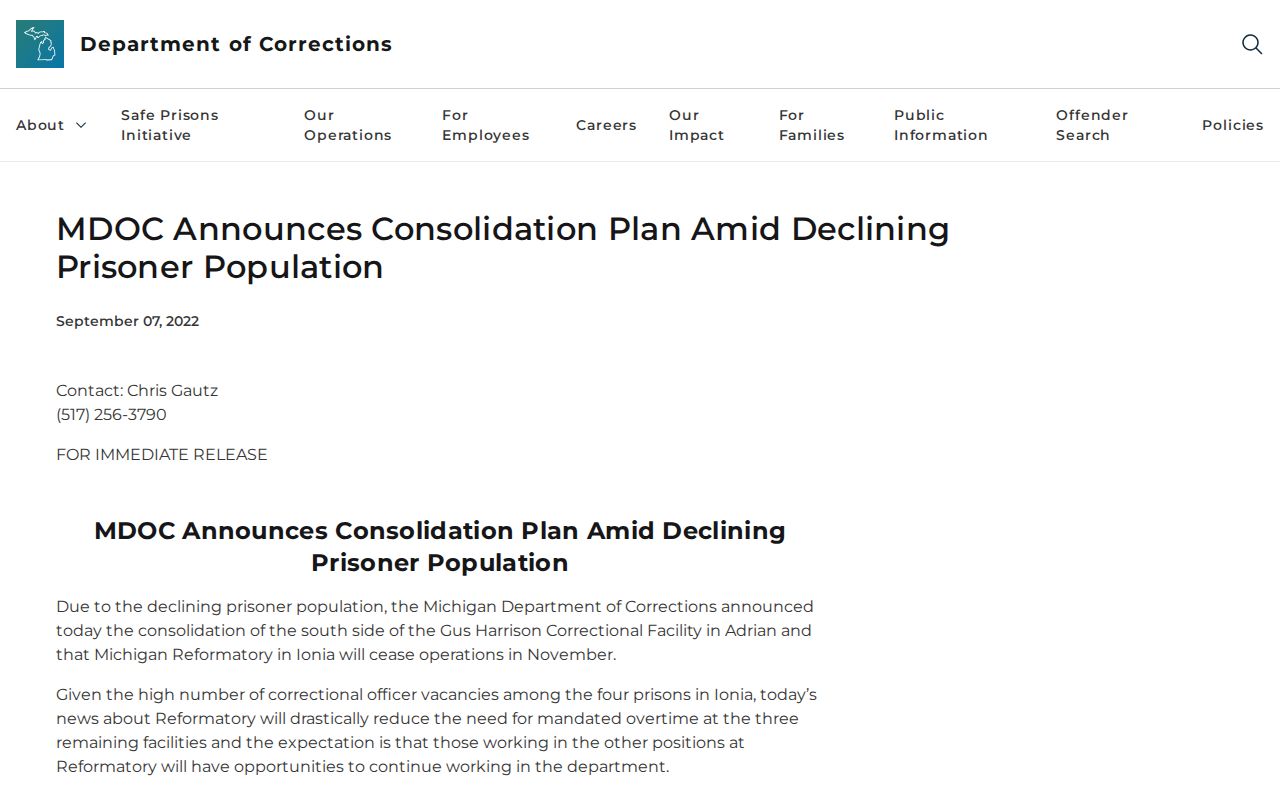
This operational change can affect the name or location seen in an older record, but it does not establish a community release event.
Gus Harrison Prison Details
The official Gus Harrison facility page describes Levels I, II, and IV custody, six residential units, and education, treatment, religious, and pre-release programs. The prison opened in 1991. Official capacity is 1,060. Those facts describe the institution, not the status of a named person.
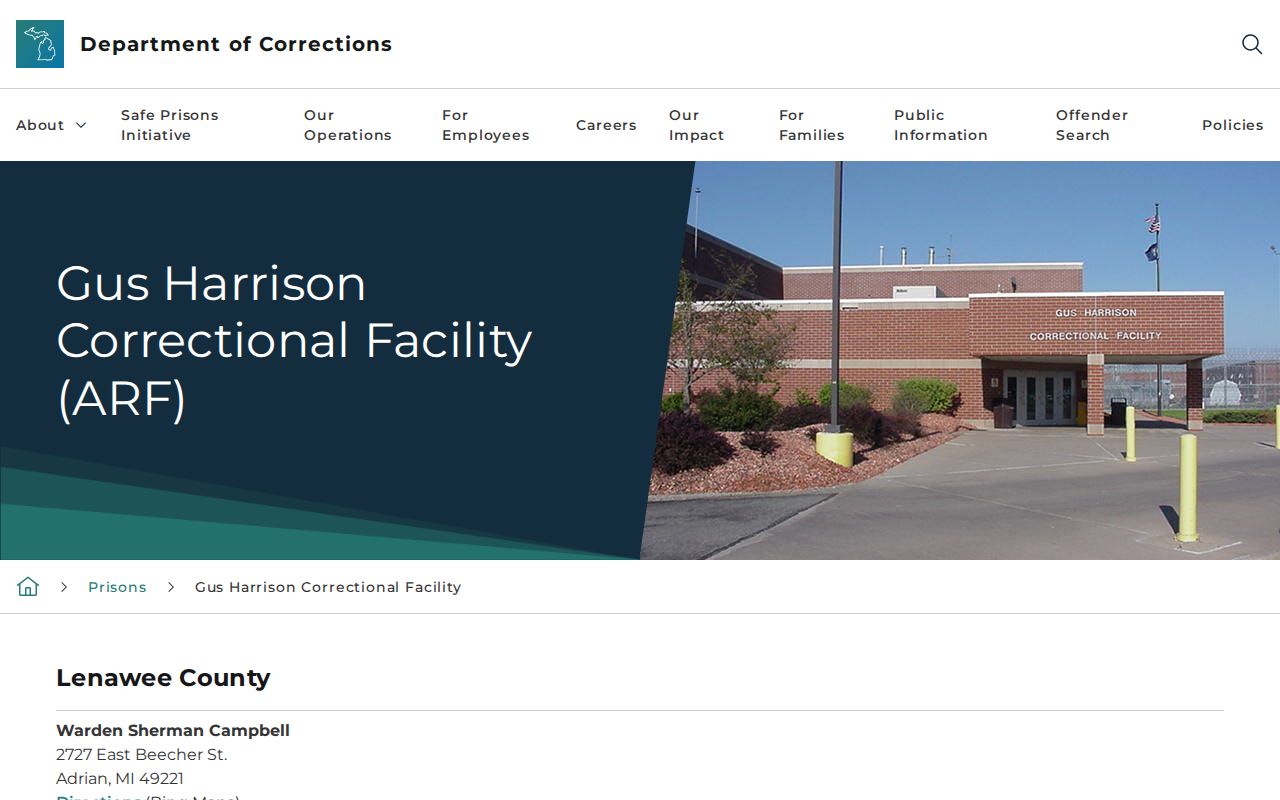
The official capture provides facility-level facts, while individual parole and discharge information must come from MDOC systems.
Gus Harrison Parole Supervision
A person paroled from Gus Harrison no longer lives inside the prison, yet the MDOC sentence continues. OTIS may show the person as a parolee and identify a supervision location. For Lenawee-area supervision, the MDOC Region 9 Lenawee office is the local contact. Staff may limit details about an individual plan, so the public record and authorized direct contact should be used together.
MI-VINE can supply a general MDOC release notification. It is an alert service, not a certified record. A release alert can corroborate a reported event, but OTIS DATE PAROLED and later supervision status better separate prison departure from final discharge. The assigned parole agent can also route an eligible person to MDOC reentry services. The Michigan Parole Board decides parole; it is not the routine reporting office.
Routine parole consideration is not published as a complete statewide interview calendar. MDOC’s press-release index includes selected statutory public-hearing notices for certain lifer and clemency matters, but those event notices should not be read as a list of all Gus Harrison decisions. OTIS is the public status and date check after the ordinary process. Direct victims who qualify for broader prison or parole notices use the separate MDOC Crime Victim Notification channel in addition to general MI-VINE registration.
MDOC Region 9 Lenawee Office425 N Main Street
Adrian, MI 49221
517-264-4580
Gus Harrison Records Contact
Call the facility for an institutional question. Use OTIS for public offender status and the Region 9 office for parole supervision within its disclosure rules. General OTIS help is available through MDOC Corrections Information at 517-335-1426 or CorrectionsInfo@michigan.gov. Court-derived errors must go to the sentencing court, while supervision-status errors go to the supervising office.
Gus Harrison Correctional Facility2727 E Beecher Street
Adrian, MI 49221
517-265-3900
The Lenawee County Sheriff does not hold a Gus Harrison discharge record merely because both agencies operate in Adrian. Matching the source to the custodian is the key step. Note: A blank OTIS result should trigger spelling, ID, scope, retention, and transfer checks, not a claim of release.