
Lenawee Parole and Probation Compared
Parole permits an eligible Michigan prisoner to leave prison and serve the rest of a sentence in the community under Michigan Department of Corrections supervision. It does not erase the sentence. Probation is imposed by a court as a community sentence. A probationer may have spent time in the Lenawee County Jail, but probation does not by itself prove a prison release. These distinctions determine which record and office can confirm a status.
Lenawee County has two supervision paths that are easy to confuse. MDOC Field Operations handles state felony parole and probation. The 2A District Court has its own probation office for district cases. Both offices are in the Judicial Building in Adrian, yet they have separate telephone numbers and authority. The underlying judgment, the court level, and an MDOC number help identify the correct route.
| Feature | Parole | Probation |
|---|---|---|
| How it begins | Release from an MDOC prison after a Board decision | A community sentence ordered by a court |
| Custody meaning | Outside prison but still serving the sentence | May begin without a prison term |
| Lenawee route | MDOC Region 9 and OTIS | MDOC for felony supervision or 2A District Probation for a district case |
| How it ends | MDOC discharge or other lawful termination | Completion or court-directed termination of the probation term |
- Discharge
- The point when the supervising authority's jurisdiction for that sentence ends.
- Absconder
- A person the supervising authority reports as out of contact or noncompliant, not a statement of present physical custody.
- Detainer
- A request or hold from another authority that may affect custody or the destination after release.
Verify Lenawee Post-Release Supervision
Begin with the Michigan Department of Corrections OTIS search when the person has an MDOC number or a state felony case. OTIS can display prisoners, parolees, probationers, discharged people within its public retention window, and parole or probation absconder categories. The MDOC number is the most precise search key. A name search needs careful comparison because people may share a name.
OTIS does not cover a person whose only custody was the county jail. A district probation case may instead be confirmed through the court file and 2A District Probation. For felony matters, the 39th Circuit case trail can explain the sentence, but a court entry does not replace the supervising office's current status. The C39 MiCOURT portal is informational, so obtain a clerk copy when the exact order matters.
- Identify whether the case is a state felony, district case, or a county-jail-only matter. Note the case number and MDOC number when known.
- Search OTIS by MDOC number first. Read the status and location together instead of treating one date as the full answer.
- For a district probation case, review the 2A court trail and contact the separate District Probation office.
- For parole or state felony probation, contact MDOC Region 9 Lenawee after checking the public record.
- Confirm final discharge with the office or source record. Absence from OTIS can reflect retention, a set-aside, or the wrong system.
Two Lenawee Probation Offices
Two official Lenawee County supervision offices share the same street address. Their functions do not. The MDOC Region 9 Lenawee office handles state felony parole and probation. The 2A District Court Probation office handles district probation. Sending a question to the wrong office can produce a delay or an incomplete answer even though both are in the Judicial Building.
The court number and sentence type resolve the split. A parole record belongs with MDOC because parole follows prison. A district probation order belongs with 2A District Court. Staff may limit details, so frame a request around whether the identified office supervises the person and where an official public record can be obtained.
MDOC Region 9 Lenawee
425 N Main Street
Adrian, MI 49221
517-264-4580
State felony parole and probation supervision
2A District Probation
425 N Main Street
Adrian, MI 49221
517-264-4681
Monday through Friday, 8:00 a.m. to 4:30 p.m.
The official Region 9 directory shows the Lenawee office used for state supervision.
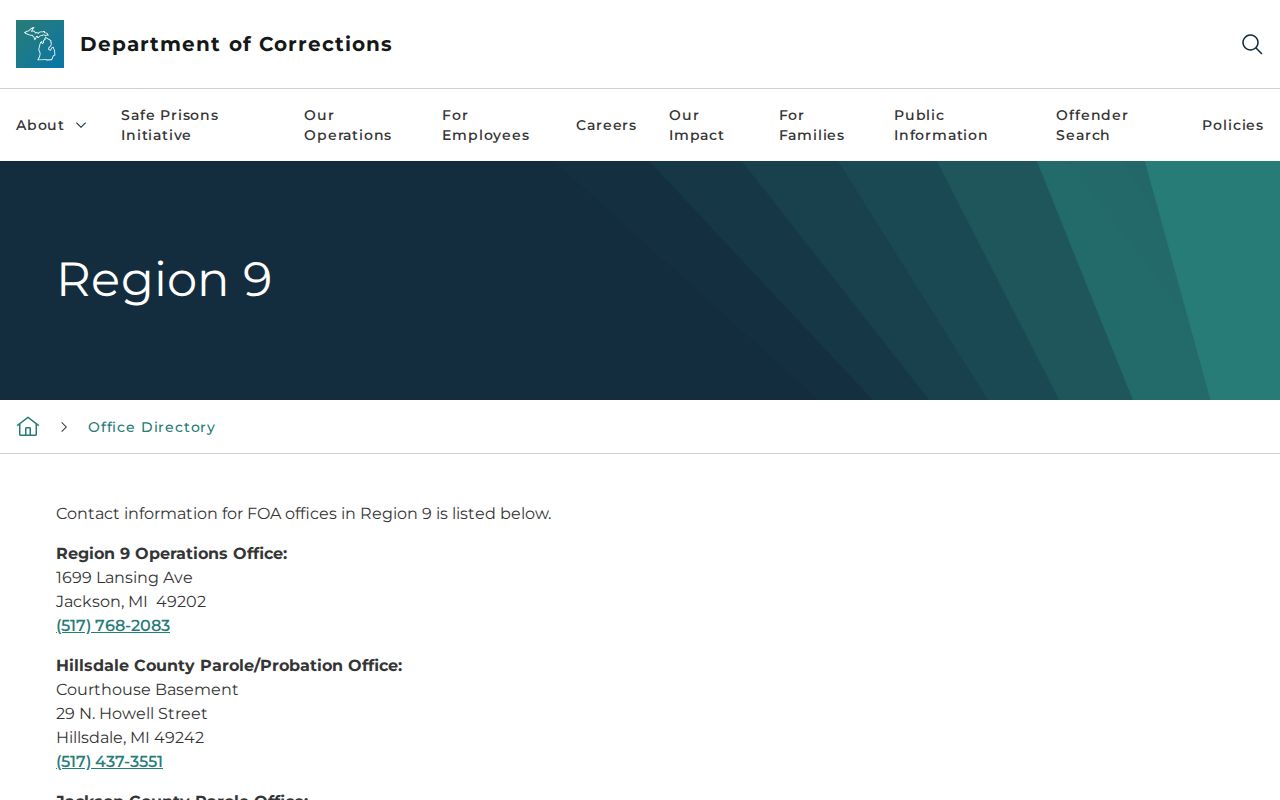
The directory image reinforces why the office must be matched to an MDOC case rather than to the county location alone.
Note: The offices share an address, but the state and district phone numbers lead to different supervision systems.
Lenawee Supervision and Absconder Status
An absconder label reflects a supervision problem reported by MDOC, such as loss of contact. It does not say where the person is now. OTIS offers parole-absconder and probation-absconder filters, and the last supervising location may remain visible. That location is not reliable proof of current presence in Lenawee County.
A parole-violation warrant can lead to detention and return to custody. Still, the warrant, arrest, transfer, and final disposition are separate events. Verify the OTIS status with MDOC and check the responsible court or law-enforcement office when a warrant record is involved. MI-VINE may report a new custody event from a participating source, but an alert is not a certified supervision record.
General conditions require compliance with the terms set for the individual. A claimed violation must be read through the official decision or order. Do not infer a violation from a missed online entry, and do not treat an absconder category as a new conviction.
Lenawee Parole Decision Timeline
The Michigan Parole Board is the sole paroling authority for MDOC prisoners. Routine consideration commonly starts about six months before eligibility or reconsideration. It generally includes a secure video interview with one Board member followed by a panel decision. Most decisions use a three-member panel. Life-sentence matters follow different voting and hearing rules.
No complete public calendar or routine decision-results portal was found. The MDOC press-release index contains selected statutory public-hearing notices, not every routine parole interview. OTIS remains the public status and date check. Possible routine outcomes include a grant, denial, or later reconsideration. A grant may also be suspended or rescinded before release when new information or conduct changes the case.
The official consideration process states that at least 28 days generally separates a release decision from physical release. The Parole Release Unit coordinates the date, terms, special conditions, notices, and placement. This gap is why a favorable decision cannot be called an actual release.
The official process page illustrates the steps between consideration and release.
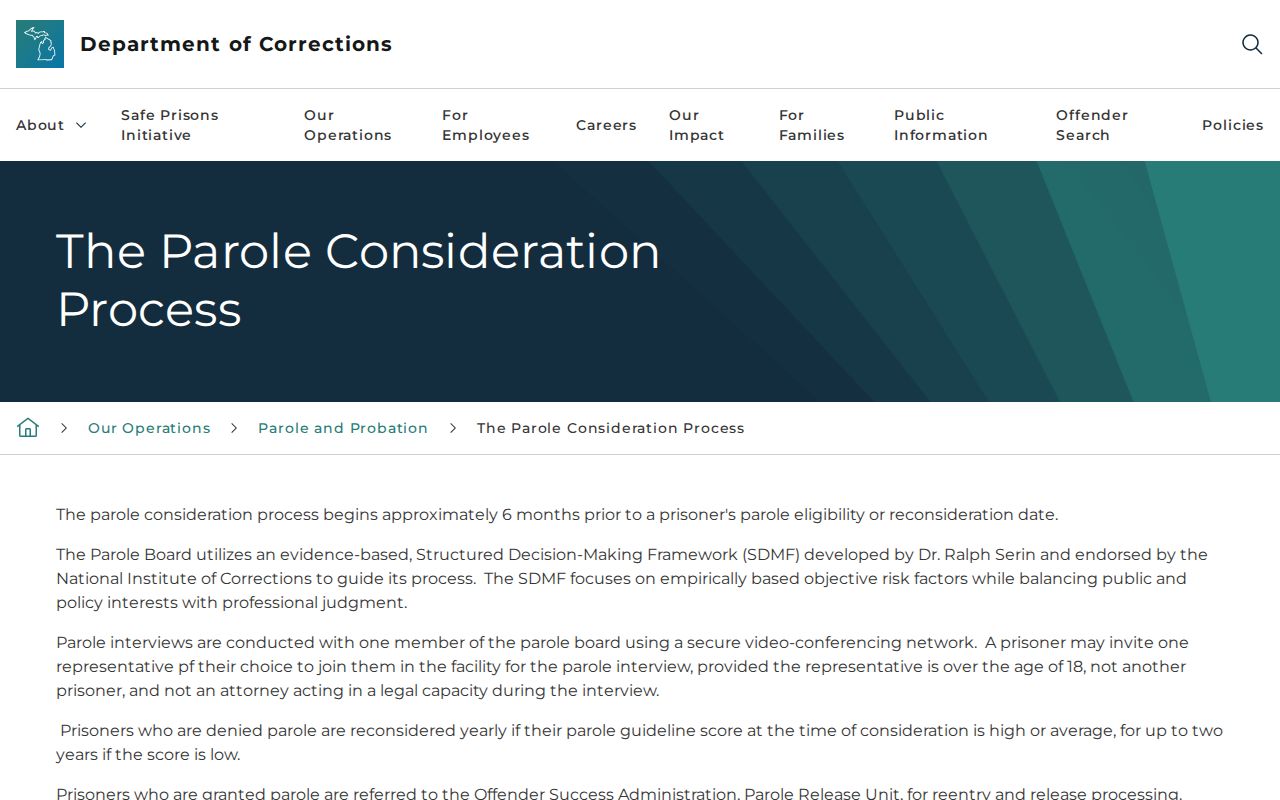
The screenshot supports the distinction among eligibility, decision, release planning, and the date the person physically leaves prison.
Lenawee Parole Reentry Referrals
The assigned parole agent is the gateway for eligible Offender Success help in Lenawee County. MDOC directs family members to the agent when a person needs an assessment or referral. An agent can refer an eligible person even when the Parole Board did not mark those services in the original parole decision. That local path is more direct than asking the Board, which decides parole but does not serve as the routine reentry contact.
MDOC Reentry Services describes support navigation for health, behavioral health, and social needs. The agent remains central because services depend on eligibility and the supervision plan. If the assigned agent is not known, start with Region 9 Lenawee and provide enough case information to route the inquiry.
The official reentry page shows the state program behind agent referrals.
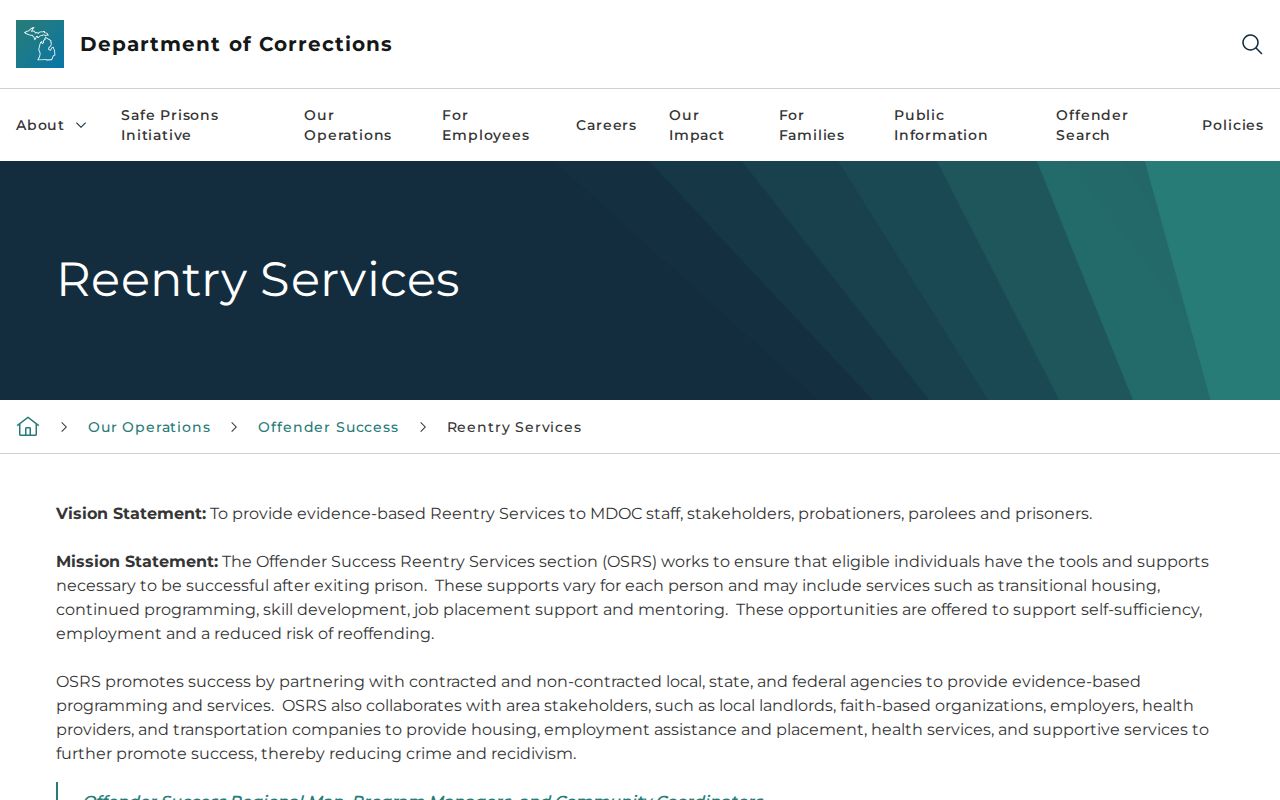
The image connects Lenawee County supervision with the statewide Offender Success referral route available through the assigned parole agent.
Correct Lenawee Supervision Records
OTIS corrections follow the source of the information. A court-derived error, such as a sentence or judgment fact, must be raised with the sentencing court. A current supervision or absconder-status issue belongs with the supervising office. Identity issues may require the proper Michigan State Police process. Corrections Information can also route an OTIS question at 517-335-1426 or CorrectionsInfo@michigan.gov.
This source split matters after a Lenawee County jail-to-prison transfer. Property left at the jail for a person sentenced onward to prison remains there for the person designated by the inmate. The jail states that after 30 days it may be destroyed or donated. That property rule is a jail procedure, while the later parole or discharge record belongs to MDOC. The Lenawee jail FAQ is the source for the property timeline.
A full Lenawee County released-person search and county release-record request begins on the home page. It should be used when the question concerns the jail exit rather than state supervision.
Lenawee Parole and Probation Discharge
Discharge is the key endpoint in an MDOC record. OTIS uses DISCHRG to indicate that MDOC no longer has jurisdiction for that sentence. A person can therefore be released from prison on parole long before final discharge. For a probationer, the end of the court-ordered or MDOC-supervised term is also distinct from any prior jail release.
OTIS generally displays people discharged within three years after supervision discharge. A record beyond that window may no longer appear. A qualifying set-aside can also remove public OTIS information. Neither condition proves that supervision never existed. The sentencing court, the supervising office, and a permitted official record are the fallback sources for older or corrected information.
Michigan law ties parole eligibility and release to MCL 791.234 and MCL 791.233. Eligibility starts consideration. It does not command release. Final confirmation should identify the authority, the current status, and the actual discharge event rather than rely on one isolated date.